
Mathematical Modeling · Operations Research
Emergency Evacuation Sweeps: HiMCM 2025, Team 17659
A Meritorious-designated paper from the 2025 HiMCM (COMAP): modeling building emergency sweeps as a multi-agent graph traversal problem, solved through a four-layer framework — exact MILP, electrical flow relaxation, ant colony optimization, and discrete-event simulation — with a working interactive simulator.
Materials & release status
- Competition paper (Meritorious, Team 17659) In preparation for release — Team-authored paper; COMAP rules allow team release, consent flow pending
- Model & solver code (MILP / ACO / DES) In preparation for release — Runs locally; packaging and seed documentation under way
- Interactive evacuation simulator In preparation for release — Existing teaching build; being reworked for reproducible experiments
Overview
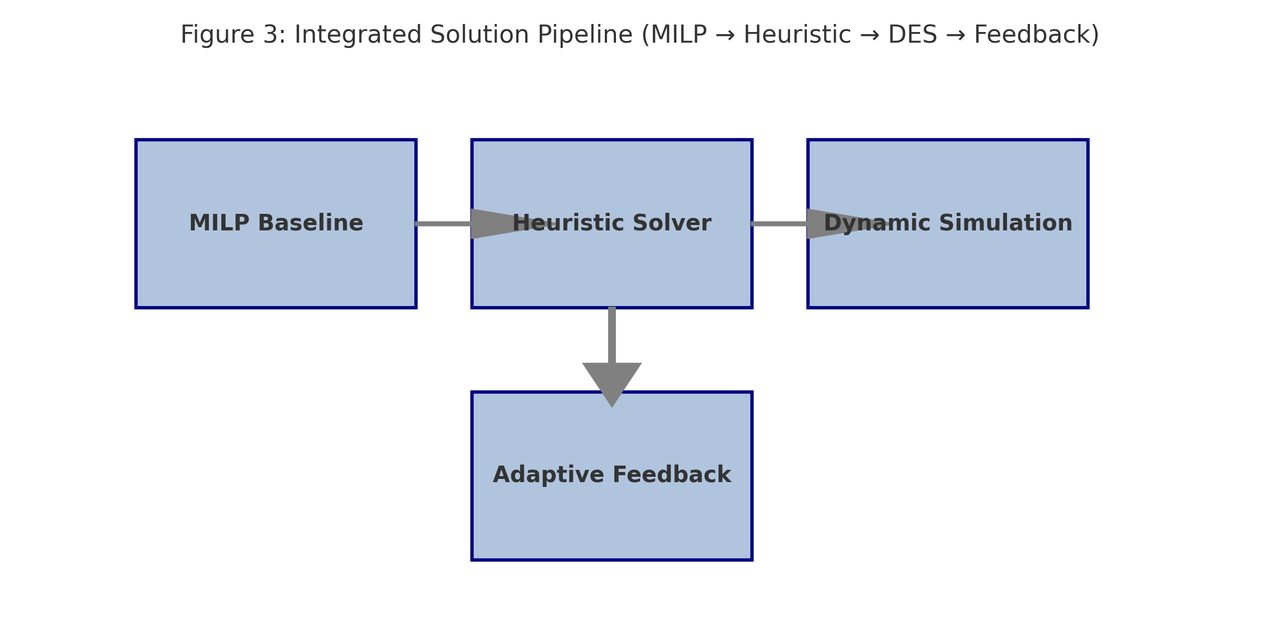
The 2025 HiMCM Problem A asked teams to plan emergency evacuation sweeps — responders moving room to room through a building that is actively trying to kill the schedule: hazards appear, rooms block, teammates fail. Academy team 17659 answered with a paper that reads less like a contest entry and more like an operations-research study: a MILP baseline for exactness, an electrical-flow relaxation for structure, ant colony optimization for scale, and a thousand-trial simulation layer for the truth. COMAP designated the paper Meritorious. What the Academy is prouder of is the archive behind it — ten full paper versions, reproducible figures, an AI-use disclosure, and a working simulator anyone can run.
Run it yourself. The team’s interactive Evacuation Simulator — layouts, hazards, and agent behavior — ships with the paper.
Open the Evacuation Simulator →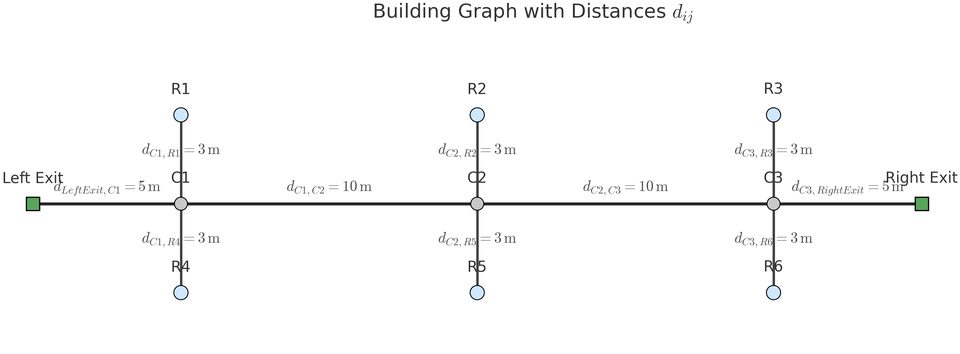
The Documentation
How this work was done
Structured by the Academy's inquiry cycle — the same eight steps every piece of documented work must show.
The Question
When a fire or gas leak forces a building to empty, trained responders sweep room by room to guarantee no one is left behind — so how should a small team route itself through an unfamiliar, changing layout to clear every space as fast as possible?
Assumptions
The team models the sweep as a multi-agent graph traversal problem — rooms as nodes, connections as edges — and assumes optimality, scalability, and resilience cannot come from any single method, which is why the framework has four layers rather than one.
Model & Method
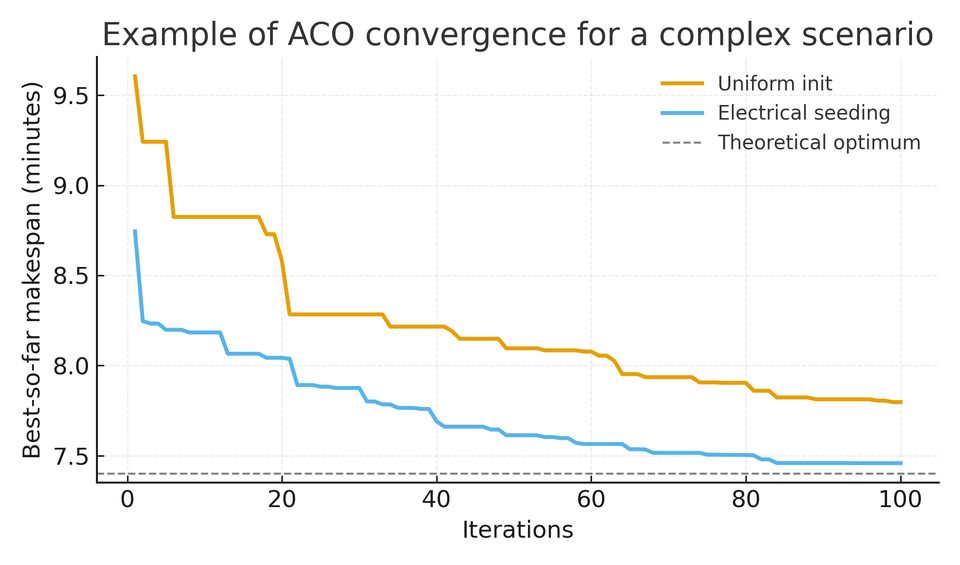
A four-layer framework. Layer one: a MILP baseline that returns exact optimal routes for small layouts. Layer two: an electrical flow relaxation — solving a Laplacian system — that identifies high-current corridors and priority rooms, generating physics-based guidance. Layer three: ant colony optimization seeded by those flow-based priorities, constructing near-optimal routes at scale. Layer four: discrete-event simulation stress-testing every solution against hazards, blocked rooms, delays, and team failures. The team also built an interactive Evacuation Simulator to visualize layouts, hazards, and agent actions.
Evidence
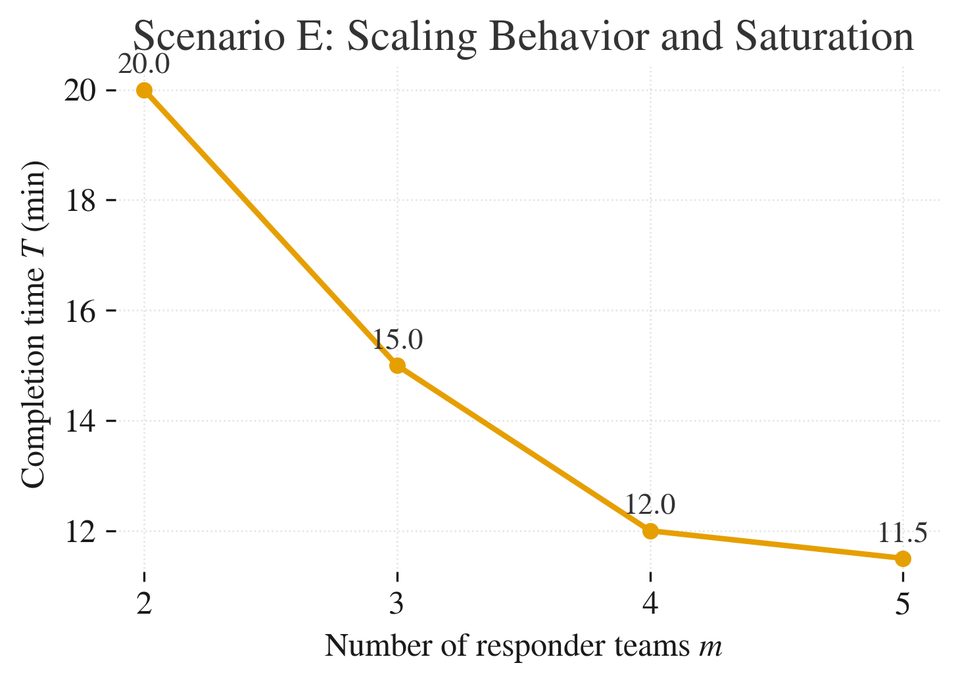
Documented results across the paper’s experiments: in a six-room scenario, two responders clear the building in 6.2 minutes versus 8.7 for a greedy approach; ACO lands within 3–5% of MILP optima while running over 90% faster; in a 15-room case, average sweep time drops from 10.8 to 7.4 minutes; across 1,000+ DES trials per layout, ACO clears 95% of runs under 6.8 minutes versus 9.9, cutting workload imbalance by 58%. Overall the framework improves clearance times by 26–41%.
Uncertainty
The DES layer exists precisely because the model’s claims must survive uncertainty: every headline number is reported against 1,000+ simulated trials with injected hazards and failures, not a single clean run.
Critique
Ten full versions of the paper (V1–V10) are archived, each revision responding to internal critique of assumptions, constraint formulations, and experimental design — the Academy’s defense-revision cycle running at full speed against a fixed contest deadline.
Revision
The LaTeX source, versioned figures, experiment code, and simulator interface views are all archived, with the AI-use report filed under the contest’s official AI policy — every figure traceable to code, every claim to a logged run.
Responsibility
The team’s interactive simulator ships with the paper so that a reader does not have to trust the numbers — they can run the scenarios themselves. Full source code is included in the appendices for reproducibility and operational validation.
Outcome
No single algorithm survives contact with a real building. The exact solver proves what optimal looks like; the physics relaxation explains where priority lies; the heuristic scales; the simulation decides what to trust. The paper’s honest conclusion is architectural: reliability came from layering methods with different failure modes.