
Mathematical Modeling · Interdisciplinary
One Season, Seven Papers: The IMMC 2026 Cycle
Academy teams competed across the full 2026 IMMC cycle — autumn, winter, and international rounds — submitting seven team papers: re-drawing the 88 constellations, quantifying the carbon math of near-expiry retail, and protecting wildlife at scale in Etosha National Park.
Materials & release status
- Seven team papers (autumn / winter / international) Restricted — IMMC committee holds publication rules over round papers; available internally
Overview
The 2026 IMMC cycle gave Force Academy teams three different rooms to think in. In autumn, a team asked whether the 88 constellations — historical accidents, not mathematical designs — could be redrawn as an honest partition of the sky. In winter, three teams took on “Save money, save the earth”: whether near-expiry discount retail genuinely saves carbon, answered with a life-cycle-assessment model and 10,000 Monte Carlo runs. In the international round, three teams flew to Namibia on paper — re-asking how a reserve the size of Etosha should spend scarce rangers, drones, and sensors when poachers choose their paths. Seven papers, one discipline: reformulate the question, then defend the model.
The Documentation
How this work was done
Structured by the Academy's inquiry cycle — the same eight steps every piece of documented work must show.
The Question
Can the same team discipline — model, evidence, limitations — hold up across three contests in one season, each with a completely different problem: astronomy heritage, food-waste economics, and wildlife conservation?
Assumptions
The season assumes variety is the test. A modeling method that only works on one problem family is a trick, not a method — so the Academy deliberately fielded teams against problems from astronomy, environmental economics, and conservation operations.
Model & Method
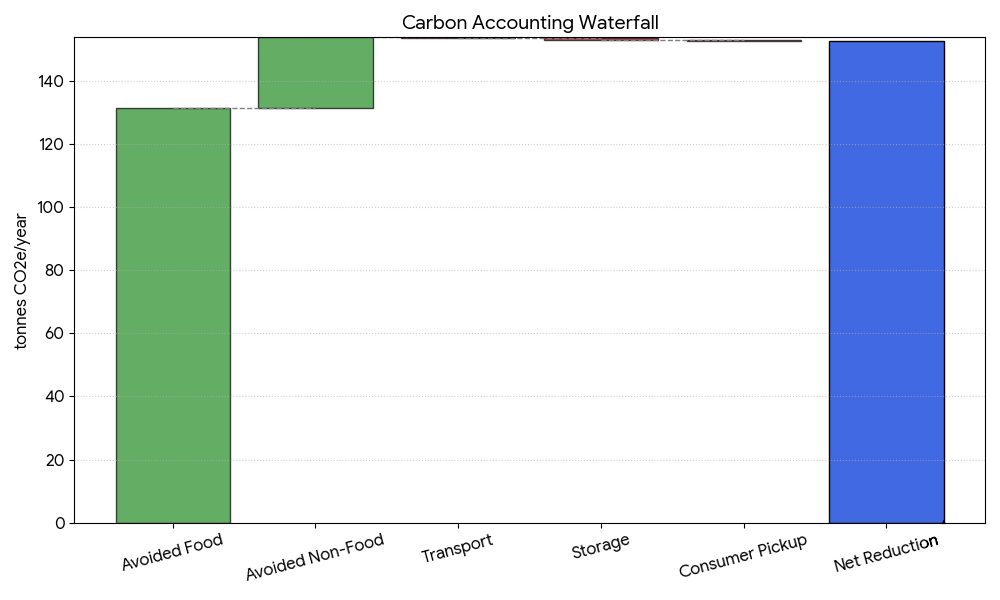
Autumn: the 88 IAU constellations — regions never mathematically designed — are re-examined as a geometric partition problem. Winter (Problem E, “Save money, save the earth”): a life-cycle-assessment (LCA) model for near-expiry discount retail, quantifying avoided emissions (production and disposal that never happen) against added emissions (transport, storage, consumer travel). International (IM2C, “Protecting Wildlife at Scale”): ranger, fixed-device, and drone deployment across a reserve the size of Etosha National Park — with one team reformulating poaching control as a weighted loss-flow interdiction problem and another importing epidemiological control theory into conservation.
Evidence
The seven archived papers and their control numbers. The winter Problem E paper, fully documented: a baseline of 60,000 kg of goods per year yields roughly 164.7 tCO₂e of net carbon reduction — about 2.75 kg CO₂e avoided per kilogram sold, with added operational emissions only 4.04% of avoided emissions; a 10,000-run Monte Carlo simulation puts the 95% confidence interval at [106.9, 231.4] tCO₂e, positive across every run. The international papers carry their own headline reformulations — from patrol-coverage thinking to loss-flow interdiction, and from coverage to epidemiological protection metrics.
Uncertainty
The winter paper’s confidence interval is the model speaking honestly: 106.9 to 231.4 tCO₂e per year is a wide band, and the paper says so — the sensitivity analysis names waste-diversion rate and food sales volume as the two parameters that dominate the answer.
Critique
Each paper went through the Academy’s mock-defense cycle before submission — the autumn constellation paper alone ran five full versions, with the archived revision trail showing what critique changed and why.
Revision
The archive holds every round of every paper: problem statements, versioned drafts, LaTeX sources, Python figure pipelines, and the submitted control-numbered PDFs — seven papers a reader can audit from first assumption to final claim.
Responsibility
Every submission carries the Academy’s AI-use disclosure. The winter team also built a plain Excel tool so a real retailer can enter its own operating data and test the model’s claims against reality — a model that cannot be checked by its users is a claim without responsibility.
Outcome
Three problems, one consistent result: the winning move is always the reformulation. Constellations became a partition problem; discount retail became avoided-versus-added emissions; poaching became flow interdiction. Teams that kept the problem in its original framing ran out of time; teams that re-asked the question finished with something to defend.